Trump’s New World Order
How US foreign policy is re-shaping the Global Order and What it Means

When the Department of War was re-named the Department of Defence, in the late 1940s after World War Two, it signalled a shift in how the US saw the outside world. This was a new era defined by rules, alliances, the steady hand of American leadership that operated on a specific logic: that a rising tide lifts all boats. We called it the “liberal international order” and it was a win-win mindset.
Thus, the symbolic rebranding of the Department of Defence back to the Department of War in early 2025, hints at a definitive shift in direction. It is a move away from the language of "deterrence" and toward the language of "assertion." This is not a mere nostalgic nod to the past; it suggest the U.S. is abandoning the defensive posture of the post-Cold War years in favour of a proactive, combat-ready stance designed to enforce a new global system. It is no longer about winning together, it is about winning alone, it is a fundamental recalibration of the global world order designed to cement U.S. power for the next century.
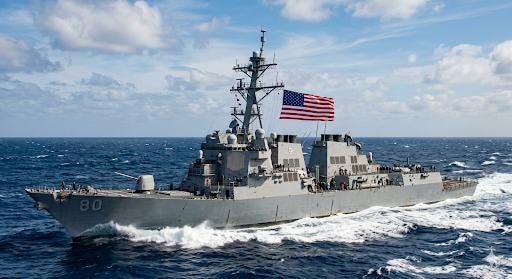
The most visible, sign of this shift is the systematic withdrawal from Europe. For eighty years, NATO was the bedrock of global security. Today, it is viewed by Washington as a legacy cost or a protection racket that no longer serves American interests. By threatening to cut NATO off and stepping back from European security, Trump is essentially telling the continent to fend for itself. This isn’t isolationism in the traditional sense; it’s a strategic abandonment which will lead to a weaker Europe that is no longer a competitor.
The administration then moved to dismantle adversarial regimes in Latin America, replacing "strategic patience" with a doctrine of forced regime change. In Venezuela, the U.S. moved beyond sanctions to a total maritime blockade and the seizure of all foreign assets. Despite this, Nicolás Maduro remained stubborn, refusing to cede power even as the country faced total economic collapse. This culminated in a daring, high-stakes military operation where U.S. special forces seized Maduro and transported him to the United States to face trial, effectively ending his regime overnight.
Cuba, which relied heavily on Venezuelan black market oil, has now been placed under a maximum pressure siege, with the U.S. demanding the expulsion of all Russian and Chinese presence as a condition for its very survival. Rumours are that the Castro regime, which has been in power since the 1959 revolution, is on the brink of total collapse and surrender. The message to the region is simple: the Americas are being consolidated into a unified U.S. fortress, and those who do not align with the new order will not only be treated as hostile outposts, but will be overthrown.
Iran was next on the list and the fact that the regime had been chanting '‘death to America” for decades and was already an adversary of US allies in the Middle East made the justification somewhat straight forward. After an extensive and on-going bombing campaign, that has wiped out the Iranian navy, air force, leadership and air defences, Trump will seek to develop a new relationship with Iran in which it maintains a military presence in the region which gives the US strategic control over a vital trade and energy choke point.
The administration has also developed a real focus on the world’s maritime choke points as part of this new global strategy. The goal is absolute control over the three most critical gateways of global commerce:
The Panama Canal: Ensuring total Western hemispheric dominance.
The Strait of Hormuz: Giving Washington a veto over the world’s oil flow.
The Straits of Malacca: The jugular vein of the Asian economy.
By projecting naval and political power over these narrow strips of water, the U.S. can effectively decide who gets to trade and who doesn’t. This ensures that any nation, friend or foe, that wishes to participate in global trade must do so under terms dictated by Washington.
Perhaps the most potent tool in this new order is the total dominance of the energy market. The U.S. has moved beyond energy independence; it is now aggressively pursuing the status of the world’s largest energy exporter. By flooding the market with American oil and gas, the administration is making the rest of the world reliant on U.S. energy. When other nations rely on you to keep the lights on, they are less likely to challenge your geopolitical moves. This shift turns energy from a commodity into a leash. It undercuts the influence of OPEC, while making Europe and parts of Asia tethered to American exports.
Everything in this strategy ultimately points toward one target: China. In the old world order, the US tried to engage China, hoping they would become integrated into the global liberal order as a cooperative stakeholder. Instead, China developed its own global ambitions and now the Trump administration views China as the only real rival, a peer competitor that must be contained, not managed. By controlling trade choke points and energy flows, the U.S. builds a ring of steel around the Chinese economy. If China cannot secure its own energy routes or trade lanes without passing through U.S.-controlled zones, its “Belt and Road” initiative becomes a road to nowhere.
It is important to add that there is very little to stop this transition. The institutions that used to check American power (the UN, the WTO, the EU) have been weakened to the point of irrelevance. Domestic opposition is fragmented, and the economic logic of “America winning” is a powerful drug for a disgruntled electorate. In military terms, no country even comes close to the US, in terms of size or technology. So once that huge military is fully flexed there is very little anyone else can do.
Ultimately, the Trump administration has confronted a fundamental geopolitical reality that previous eras of leadership failed to fully grasp: in a global landscape defined by finite resources and the relentless acceleration of technological change, power belongs to those who dominate the energy landscape. By prioritising the control of critical supply chains and strategic bottlenecks, the administration is not merely pursuing domestic prosperity, but is actively re-engineering the global balance of power. By seizing this leverage now, Trump is seeking to ensure that America remains the defining force of the international order for decades to come.